Tuesday, 8 September 2015

Herbst - Drömling

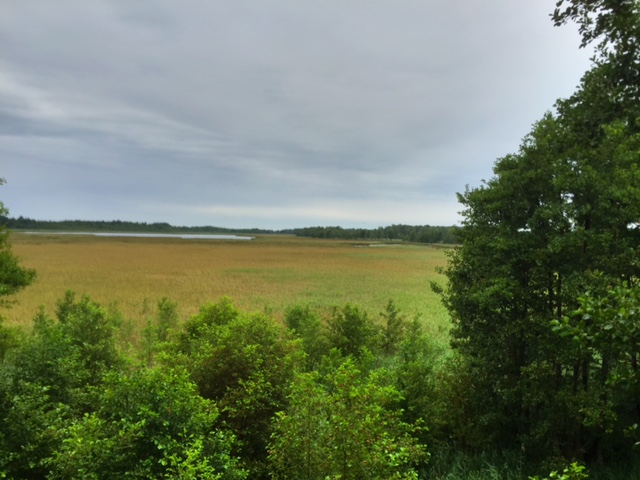
A short post following a visit to the Drömling this morning.  The weather was initially overcast with sunny periods developing steadily as the morning went on.  The temperature was about 18C.  I have written about the Drömling before - its a huge area not suited for the concentration of migrants and is at its best in Spring when its fit to bursting with newly arrived birds, and late Autumn when the Cranes and Geese are passing through.  Small migrants will pass through on a broad front and are therefore not easy to see. 

Map extract - Drömling
Not surprisingly Swallows were much in evidence skimming across the meadows catching insects.  A few House Martins were also present.  A First Summer Redstart showed nicely on the edge of a bush line.  Amazingly I had not yet seen this species in Germany and so it was new both for the location and the country - for me at least.  Soon afterwards I was surprised by an adult White-tailed Eagle which, as is becoming a habit with this species, approached me from behind.  This is the third time I have seen this species here.  A Lesser Spotted and Great Spotted Woodpecker flew over - the former is scarce and is therefore a good sighting

Swallows - Drömling

First Summer Redstart - Drömling


Adult White-tailed Eagle -  Drömling

Roe deer were much in evidence - they are very common in Germany and roam freely all over the Drömling.  I saw 15 today - they obviously knew that no hunters were about.  Whinchats were quite common and make a nice change from their Stonechat cousins.  A Garden Warbler briefly showed its face before disappearing deep into the bushes again. And, last but not least, a couple of Ravens cavorted overhead against the now blue sky.  Some Common Buzzards and Red Kites added a bit of variety on the raptor front.

Roe Deer  -  Drömling


Whinchat  - Drömling

Raven - Drömling

All in all a pretty uneventful visit and proof that you need to time your visits to get the best from wherever you're going.


Friday, 4 September 2015

Herbst - Frose

Time to get back to the birds.  Autumn is here and things ought to be beginning to move.  A visit to Frose was in order to see what was coming through.  I had also read some reports of late summer congregations of Bee-eaters hawking over the water and was keen to see if I could see some.  I've been to Frose several times attracted by its diversity and the abundance of species - I've seen, after this morning's visit, 68 species here.  The weather was calm and warm - 20C.  A beautiful early autumnal day.
 
Map extract - Frose and the Concordia See

Frose village from over the reed beds
First impressions weren't too optimistic.  I'd timed my arrival so as to arrive mid-morning when the air would be warmer and therefore more conducive to insect activity.  Certainly compared to my visits in the early spring when the place was a cacophony of bird song, it was eerily quiet.  Halfway along the track bisecting the reserve are two expanses of water one of which contains a drowned wood.  The left hand area is more open and shallow and contained the wonderful sight of nearly 200 Lapwings. Often overlooked, these birds are really beautiful, particularly so when the entire flock, spooked by a local Marsh Harrier erupted into the air, their black and white wings contrasting spectacularly against the sun.  Accompanying the Lapwings were several Ruffs in winter plumage and right at the back, beyond camera range, a handful of Dunlins.  So, something was coming through and both waders were new to me at Frose.

Lapwings at Frose
Juvenile Marsh Harrier - Frose

Ruffs at Frose
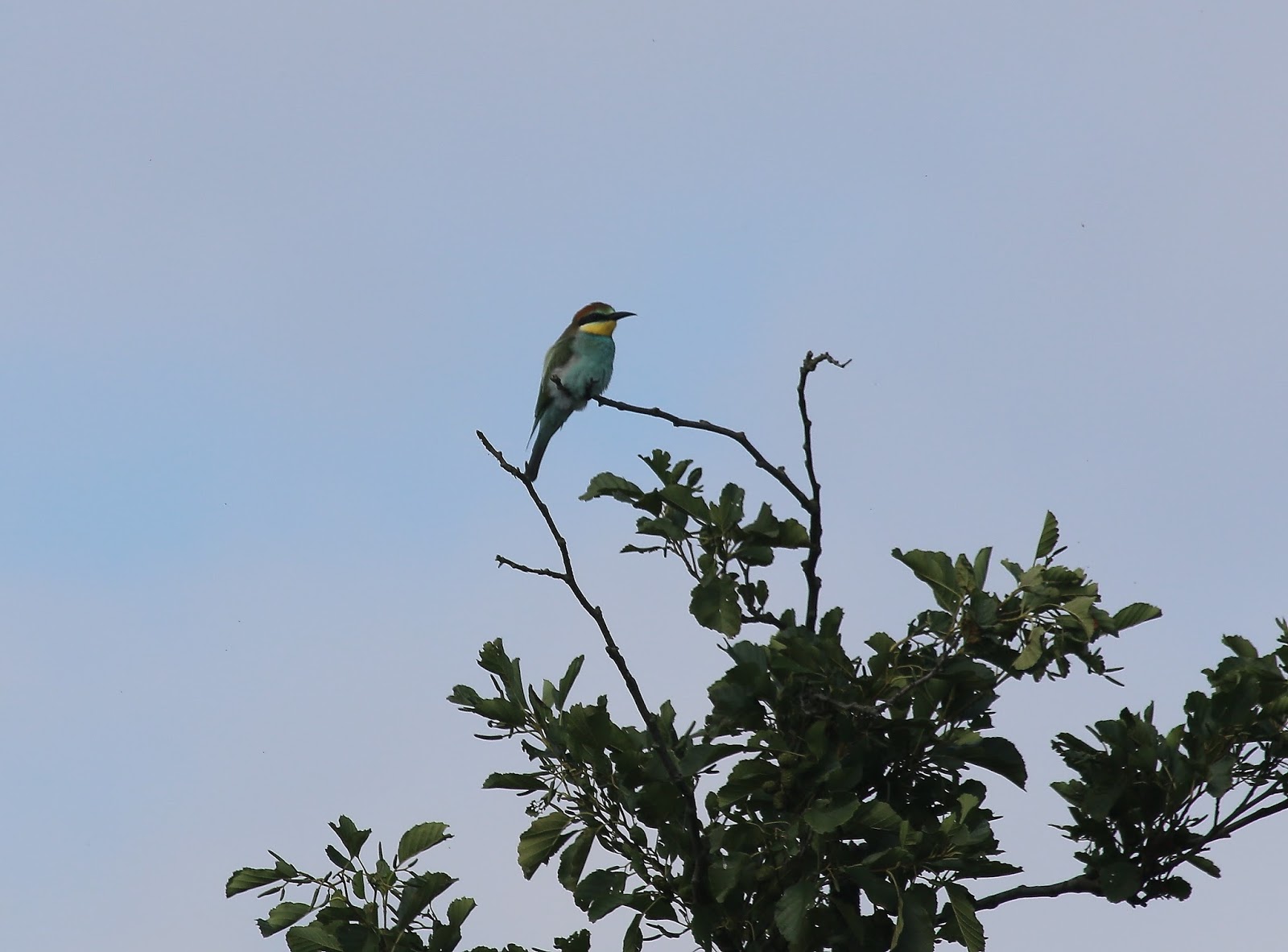
On I walked pondering all the species I'd seen here in the Spring - nearly all of the warblers were gone save only for a softly plumaged gentle-faced Marsh Warbler and a couple of their Reed brethrens chuntering from deep within the reed beds.  I played cat and mouse with a juvenile Cuckoo hoping for a shot but he or she proved too elusive - always moving on in that long-winged elastic way of theirs.  There really didn't seem to be that much about, especially on the passerine front.  The other lake was graced with 12 Great-White Egrets and some Grey Herons whilst the sky was filled with hirundines fattening up before the long haul south.  Suddenly the air was filled with a quipping sound indicating the arrival of a 10 strong flock of Bee-eaters flying on stiffly held wings over the water.  This species is most obliging in the sense that they're easy to photograph posing obligingly on dead trees in the middle of the lake.  I spotted at least one juvenile bird and assume this raiding party came from the Osmarsleben colony I had visited in June.


Bee-eater - Frose

Bee-eater - Frose

White Storks flying over Frose
Turning back towards the car I picked up 3 White Stocks heading south which, when added to the handful of migrating Cranes I had seen the other day from the car, indicate that the big bird passage has started too.  Frose seems to attract large numbers of Starlings maybe because there is so much suitable roosting habitat.  Large numbers wheeling across the reed beds is a spectacular sight and certainly worth observing not least as a fascinating behavioural characteristic.

A flock of Starlings over Frose

One of ten Great White Egrets - Frose
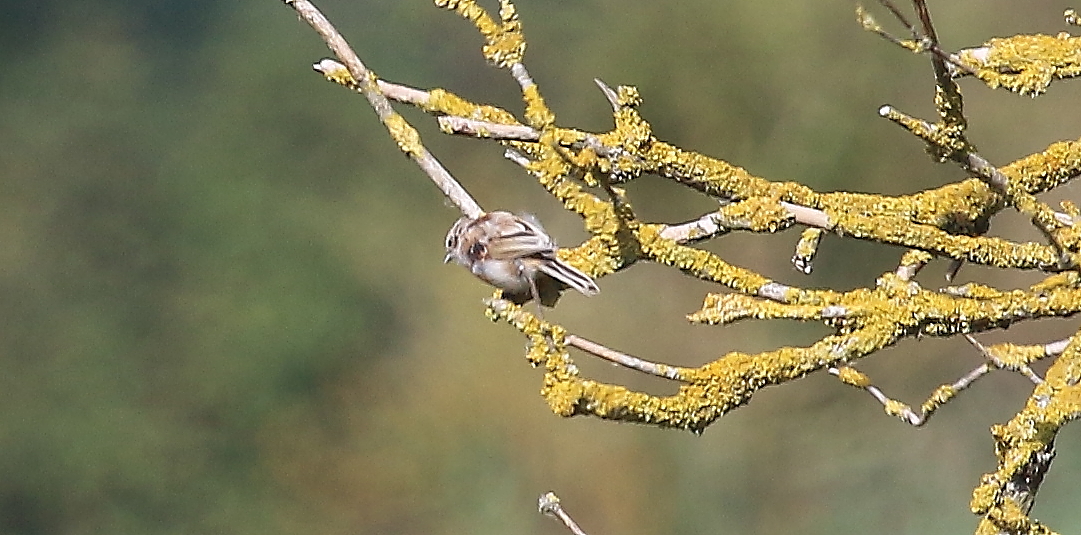
Finally, I was really please to find a couple of juvenile Penduline Tits - another new species for me at Frose - which despite being widely distributed, aren't that easy to come by.  This couple were certainly easier to photograph than their bearded cousins which never stay still long enough for me to get a snap.  Lastly, just as I approached the car, some Sand Martins flew over head.  Here's the morning's list then: Great White Egret (12), Grey Heron (11), White Stork (4), Marsh Harrier (several), Buzzard (5), Lapwing (circa 200), Dunlin (4), Ruff (8), Black-headed Gull, Woodpigeon (2), Cuckoo, Bee-eater (10), Sand Martin (5), Swallow (circa 30), House Martin (22), Pied Wagtail (2), Wren, Dunnock (2), Robin, Song Thrush, Marsh Warbler (1), Reed Warbler (2), Whitethroat (3), Willow Warbler (2), Blue Tit, Great Tit, Penduline Tit (2 juv), Magpie, Jackdaw, Carrion Crow, Starling (100), Tree Sparrow, Chaffinch, Greenfinch, Goldfinch (15).

Juv Penduline Tit - Frose
Finally, now that the summer is officially over I should return to my original subject - that of Montagu's Harriers.  Despite trying, driving and walking miles, I have seen none - save the early passage female bird in the spring.  I have looked in old haunts and promising acres of crops but must admit that I've drawn a blank.  As they say, information is power, and with so little useful intelligence and help, it was always going to be difficult - but I thought I would find some somewhere!  On the plus side I've got to know the landscape and villages north east of the Harz and have grown to love them in their inimical German way.  And I've seen a lot of great birds in the process and all under my own steam.  Next week the Drömling, but today Frose did not disappoint.

Friday, 7 August 2015

Where angels fear to tread

My wife and I are blessed in having two beautiful boys: Oscar aged 14 and Max who is 12.  Max, who we adopted in 2008, has Attention Deficit Hyperactivity Disorder (ADHS).  Throughout the past 2 or 3 years, this condition has come to significantly affect Max and all those around him.  Life for us all has become so difficult that we have decided to send Max to a boarding school catering for ADHS and other behavioural conditions.  We will take Max to his new school in Paderborn in Germany on the 11 Aug, and this post is written in tribute to him.

I think this is my first photograph of Max taken in the New Forest in Jan 08.  On his right is his mother Christine and on his left is a close family friend Caroline
Max with his auntie Dolly in Dorset in August 2015
For those of you not familiar with ADHS (why should you unless you need to be), it usually manifests its self either as a hyperactive or impulsive behaviour or as inattentiveness or indeed as a combined condition.  Max has the latter.  Every parent writing about their child with ADHS, stresses the beauty inherent in their child and Max is no exception.  He is beautiful, compassionate, clever and witty but, and on the other hand Max has a deep well of anger within him probably relating to his past and when moved to anger he can be exceptionally rude - especially towards his parents.  His understanding of the concept of truth is profoundly underdeveloped and he lies frequently.  He is also extremely destructive and nearly always with other people's possessions and especially our iPads!  Despite being 12 years old, we still cannot leave Max unsupervised - whenever we have done so, significant nonsense occurs.  So, as you can see our Mouse is more than a handful!
Max - with Mummy in Salisbury summer 2008
When Max came to us aged 4 he behaved like any other boisterous boy.  The first time I saw him I was so amazed by how fast he moved, that I called him the 'Magic Mouse' - a nickname which, much to Max's occasional chagrin, has stood the test of time.  A close friend of mine - a mother of 2 boys and a girl herself - describes Max as a 'veritable force of nature' - he certainly is that!  If my memory serves me correctly, there was little evidence of the challenges that were to come - the occasional tantrums and bouts of naughty behaviour seemed quite normal and we took them in our stride.  He also got on really well with his new brother Oscar which obviously gave us much joy.  As an indication of his maturity, he decided to stay down a year at school in Salisbury by moving classes himself in order to help him manage the transition to his new school and family.  Amazingly, when we moved to Germany 3 years ago and Max attended his new school, he learnt German, which is a complex grammatical language, in about 3 months.

Max in a relaxed mood in France in summer 2010 aged 9

We have received a great deal of social welfare support for Max and were lucky to find a wonderful school in our area which provided exactly the type of pastoral care and discipline Max needed.  His teachers understood Max's condition and supported him patiently and consistently.  When we attended his leaving ceremony there in July, my wife and I wept with gratitude.  Max has also benefited from weekly therapeutic sessions and we all as a family have been able to discuss the highs and lows of life together.  We were always advised to ensure that every naughty deed has a consequence, but when one's armoury of sanctions has been exhausted or become meaningless, what can you do?  However, at the end of day and when all the helpers have gone, we've had no alternative other than to just get on with life as best as possible.  On the whole I think that we've done really well, but we are far from perfect and Max is getting bigger and stronger and, however patient and de-escalatory we try to be, the danger of physical contest is increasing.

Max and Puckle aged 2 in Dorset in May 2015
Christine and I are confident that Max will be happy and will thrive at his new school - he is amazingly sociable and confident.  But we also know that we will miss him enormously and will count the days until he comes home - roughly one weekend in three and obviously for the holidays.  I have just spent the past week with Max in Dorset where we were joined by my sister Helen.  We had a wonderful time together exploring, walking, watching films and visiting friends - always with skateboard in hand!  Max is at his best when he is relaxed and he has been really happy here.  As a parent you always want to do what is best for your children and I hope we have made the right decision for our Mouse.  He is gorgeous beyond measure and incredibly precious.  I am confident that he will thrive and be able to develop constructively in his new school.

Postscript: this piece has been written with Max's kind permission and he is happy with its content - just in case you're wondering.

Monday, 3 August 2015

Die Müritz

Last week we spent a week 'en famille' with Christine's mother and disabled brother by the Müritz in Mecklenburg-Vorpommern.  This was always going to be a 'compromise holiday' and the opportunity to get out and see birds was likely to be restricted to very early morning forays.  The end of July is also never a good time to find birds most of whom have gone quiet turning their thoughts to migrating south.  The Müritz, which charmingly means "little sea" in Slavic, is the second largest lake in Germany and the largest lake entirely within Germany.  Its area is 117 km², its maximum depth is 31 metres and it is fed and drained by the river Elde - not to be confused with the rather larger Elbe.  On its eastern shores lies the Müritz National Park covering vast areas of lake, wetland and ancient forest.  The weather during our stay was cool and breezy.

Die Müritz - the national park is on the eastern bank
Die Müritz - a view overlooking the lake from the east bank
My guide was, as usual, Vogel Beobachten in Ostdeutschland whose chapter on the Müritz concentrates almost exclusively on the Ostufer - or the east bank, and my activity consequently focussed on the north eastern arc of forest, lakes and fish ponds you can see on the map.  Iconic species here include Ospreys, White-tailed Eagles and Cranes which can be seen here in their thousands during the autumn.  My first early morning expedition entailed a long walk thorough a forest - I had unwisely left a bike at home - to the Specker See.  On the way I saw several Great Spotted Woodpeckers, Nuthatches and tits, including a Willow.  The lake, however, was somewhat disappointing with nothing showing except for some long distant unidentifiable ducks and Mute Swans.  Fortunately my return was enlivened by an obliging Grasshopper Warbler singing its heart out and shivering its tail so fast it seemed to be vibrating - something I've not seem before.  Being able to observe this immaculate little bird so closely saved the morning really!

Specker See - Müritz national park

Grasshopper Warbler - Müritz national park


Nuthatch  - Müritz national park
The next morning I visited the Teufelsbruch and Warnker See slightly further to the north.  This time I took a bike which enabled me to cover the 18 km rather more quickly.  The landscape here is really beautiful and much loved by the Germans who holiday here in their thousands - most of them on bikes!  I should also say that the provision of viewing platforms and hides by the national park authorities is outstanding and most of them were full of families looking out for Ospreys and White-tailed Eagles.  The staring cast at the Warnker See, however, were Cormorants in their hundreds resting on the water and breeding in the trees.  A species often overlooked on account of their commonality and strange reptilian appearance, their congregation here was really fantastic to see.


Public information - wanted dead or alive!
Cormorant   - Müritz national park
Also in attendance were a pair of White-tailed Eagles cavorting over the forest throwing themselves around in the breeze as if they were much smaller birds, and up by the Teufelsbruch an Osprey cruising nonchalantly.  Finally, a Marsh Harrier drifted in and out of view.  All species seem to be common here and can be seen more or less anywhere throughout the park.

White-tailed Eagles - Müritz national park

Osprey - Müritz national park
Male Marsh Harrier - Müritz national park
There were of course many other birds, including large numbers of Greylag Geese flying to and from the water and looking wonderful with the sun glinting on their plumage. One evening I saw a murmuration of Starlings looking for somewhere to roost, wheeling spectacularly across the sky.  So here's the list - 67 species in the dog-end of the breeding season when birds are hard to come by.  Mute Swan, Greylag Goose, Gadwall, Mallard, Tufted Duck, Pheasant, Great Crested Grebe, Cormorant, Great White Egret, Grey Heron, White Stork, Black Kite, Red Kite, White-tailed Eagle, Marsh Harrier, Sparrowhawk, Buzzard, Osprey, Kestrel, Moorhen, Coot, Crane, Lapwing, Black-headed Gull, Herring Gull, Common Tern, Stock Dove, Woodpigeon, Swift, Kingfisher, Green Woodpecker, Great Spotted Woodpecker, Sand Martin, Swallow, House Martin, Meadow Pipit, Wren, Dunnock, Robin, Black Redstart, Blackbird, Song Thrush, Mistle Thrush, Grasshopper Warbler, Reed Warbler, Chiffchaff, Willow Warbler Willow Tit, Coal Tit, Blue Tit, Great Tit, Nuthatch, Red-backed Shrike, Jay, Magpie, Jackdaw, Hooded Crow, Raven, Starling, House Sparrow, Tree Sparrow, Chaffinch,, Greenfinch, Goldfinch, Linnet, Yellowhammer and Reed Bunting.

Flock of Greylag Geese - Müritz national park
Murmuration of Starlings - Müritz national park
Finally, some thoughts on Mecklenburg-Vorpommern (VP) - a north eastern state I had never visited before.  Though by no means the smallest German Lander, VP is the least densely populated.  It is a beautiful gently undulating land of forests, lakes and arable land with very little industry.  It has, I believe, a greater preponderance of Sclösser than anywhere else in Germany.  Many if not most fell into disrepair during the DDR era and the best now have a new life as a kind of German National Trust welcoming tourists and exhibiting the region's history.  I was certainly interested to visit the home of Charlotte of Mecklenburg-Strelitz (1744–1818) in Mirow, who in 1766 became the wife of King George III.  On a more worrying note VP is one of Germany's poorest regions and  many communities suffered significantly after reunification and the withdrawal in the early 1990s of Soviet forces that were stationed there throughout the Cold War.  On our final afternoon - when the sun had at last come out - we visited a old and now unused air base that had been home to Russian MiGs.  All that is now left now is some rusting military hardware acting now a tourist attraction (I suppose that's better than them being used in anger) and some fading memories of relationships made and maintained and now forever gone.
Charlotte of Mecklenburg-Strelitz

A different kind of bird - a MiG 21 near Rechlin


Friday, 10 July 2015

'Das endlose Trauerspiel'

One thing you get to learn when living abroad is that your host's national culture is likely to be very different from yours.  And so it is for me with Germany - even though my wife is German.  I suppose that there are a few superficial similarities, but we are all prisoners of our countries' pasts and actually there are very few shared cultural reference points that properly bind us together either as people or communities.  We are, whether we like it or not, rather different.


A 1 Euro coin

When reading German newspapers I am often struck by how different the German establishment's (for want of a better expression) view is on a whole range of issues compared with the prevailing opinion or consensus in the UK.  One issue that certainly does bind us together is the European Union (EU) and the Euro, even though the UK is not a member.  The latter is constantly in the news at the moment thanks to the never ending Greek financial crisis.

Strong stuff - 'Frau Merkel, we also want a referendum!  Take the Greeks out of the Euro!'

German foreign policy since the second world war has been to embed itself within first the EEC and then the EU.  Over time and more by default than by design, Germany has assumed an increasingly important leadership role in the EU mainly because of the Euro crisis and its position as the dominant economic and fiscal power.  Other crises, for example those involving Russia, have also favoured German involvement because of the significant economic and trade links between the two countries.  The German political elite remain wedded to the EU and its future - especially the Euro.  This relationship is a given, a constant, a matter of faith; it is not the pragmatic contractual arrangement envisaged by the British. 


The Bundestag in Berlin.
But are things changing?  Certainly people here are alive to the Euro crisis and many have now assumed a more questioning and sceptical stance.  I don't think most people realize how well Germany has done in the Euro and wrongly assume that their economic success is entirely attributable to the country's manufacturing brilliance.  What I think really upsets people here is the thought of handing over more money to indebted states in southern Europe, especially when they refuse to take Auntie Angela's medicine.  I wonder now whether the Germans will be prepared to hand over the political and sovereign power necessary to make the Euro work.  The acquiescent acceptance, upon which many German (and other) politician's relied to advance the cause of Europe, is I sense draining away.


So where does this leave us - or more pertinently the Germans?  Whilst Germany is certainly wealthy, there is a lot of poverty here.  The legacy of amalgamating unemployment and welfare benefits in 2005 under Hartz IV, is over 7 million people on “mini-jobs”, part-time work that is tax-free up to €450.  This flatters the jobless rate, but in the process Germany has become a split society, more unequal than at any time in its modern history. Remarkably, a fifth of German children are raised in poverty.  So many Germans quite understandably don't think that they can afford to subsidise others - and they probably have a point.  But, you make your bed and you lie in it.  If everything is sacrificed on the exigencies of a indistinct and vapid European dream, without asking the electorate first, then this is where you may end up.  We are all very different - I don't understand how the Germans could have let themselves get here, but then I don't understand them and they don't understand me.


Tuesday, 7 July 2015

Wiedehopfe - Oranienbaum Heide


Hoopoes, like Bee-eaters, are a bird most bird watchers will go the extra mile to see.  I believe that they also the most recognizable scarce bird seen by the general public out walking their dog in the spring.  With their pharaoh's crest, de-curved beak, pink body and striking black and white striped wings, they are immediately recognizable both by the lay-man as something special and by the hard-core birder as something worth running to 'bag'.

Oranienbaum Heide
Hoopoes are scarce breeders in Germany but have increased in numbers over the past decade benefiting from the effects of warming temperatures and, especially in my part of the world, the conversion of former military training areas into nature reserves.  The Oranienbaumer Heide, near Dessau, is a case in point.  Quite apart from having such an attractive name, it is a large area (2,683 hectares) of unimproved dry grazing land intermixed with forest in various states of development.  The Heide provides a home for a wide variety of heathland birds including Nightjars, Woodlarks, Great Grey Shrikes, Wrynecks (though increasingly scarce) and Hoopoes.   

Oranienbaumer Heide
Orainenbaumer Heide - note the cattle
Approximately 100 pairs of Hoopoe breed in Sachsen-Anhalt and their numbers are increasing significantly thanks to the use of nest boxes.  In the past 2 or 3 years the numbers of breeding Hoopes in Sachsen-Anhalt has nearly doubled and on one heath alone there are now nearly 60 currently held territories. Numbers are also doing really well on the heaths in Brandenburg.  I have visited several Heides over the course of the last couple of years, usually on the recommendation of the good Vogel Beobachten in Ostdeutschland guide, and have often commented on how over-grown many of them have become when compared with the photographs in the book.  Consequently many species, especially Tawny Pipits, seem to have moved out.  The Oranienbaumer Heide, however, seems to be well-managed and native cattle and horse breeds, as well as large scale tree felling, are used to maintain the right mix of habitat.

Hoopoe home?  An armour plated nest box circa 3m from the ground fixed in a young oak tree  - Orainenbaumer Heide
Juvenile Red-backed Shrike - Orainenbaumer Heide
I have visited the Oranienbaum Heide once before in the hope of seeing Hoopoes but to no avail.  Admittedly the visit was made at short notice and without any research and my colleagues and I had to make do with wonderful views of Great Grey and Red Shrikes, Golden Oriels and an amazing array of butterflies.  The weather during today's visit was extremely hot - 30⁰ centigrade - and there was very little activity to observe.  It was one of those days where you had to work really hard to see anything other than the ubiquitous Red-backed Shrikes and their families, some Stonechats and a couple of Woodlarks, which of course are lovely. 
Hoopoe - Orainenbaumer Heide
Mercifully, however, and just as I was about to give up, my attention was caught by the unmistakeable view of a Hoopoe flying into a small tree.  Thank goodness!  The bird was quite tame and allowed me to creep close enough to take some pictures.  Whilst I was waiting for it to fly from the tree into the sunlight, my attention was then attracted to some activity in the sky - namely a spanking male Goshawk flying high seemingly hawking some Swifts.  I am usually quite good with Goshawks but male birds can present identification problems with their slightly smaller and less physical female cousins.  However, the combination of bulging secondary wing feathers a more prominent head, a thick set tail and slightly slower wing beats, allowed me to identify this bird as a Goshawk.  Goshawks are widely distributed throughout Germany and can be seen, usually by chance, just about anywhere, though usually in forest habitats.
 
Male Goshawk with Swifts - Orainenbaumer Heide


Male Goshawk with Swifts - Orainenbaumer Heide
Male Goshawk - Orainenbaumer Heide
When, after all this aerial excitement was over, I returned my attention to my Hoopoe, it had gone!  Flown loopingly across the vast heath to a tree or shrub unknown.  There is no list of sightings to report - it wasn't that sort of outing and actually I saw remarkably little!  It was very hot and hard work, but I got my bird - a first for me in Germany.